Matron Burt Honoured in Guy's Gazette

Annie Graham
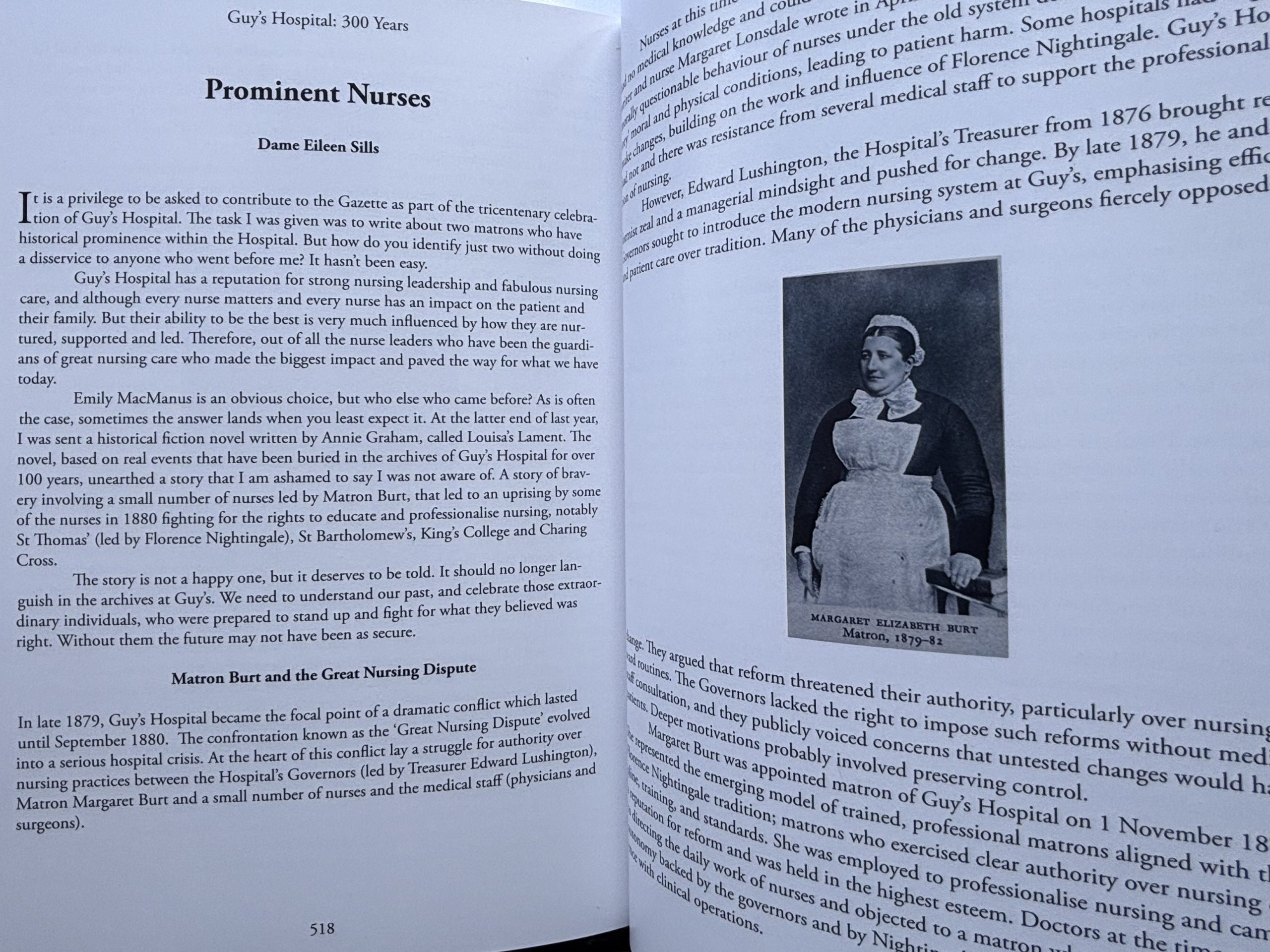
Dame Eileen Sills was asked to write about two matrons out of three hundred years of nursing history. She chose Matron Margaret Burt — a woman whose story had been buried in the archives for over a century…
When I sat down to write Louisa’s Lament, I knew I was telling a story that had been forgotten. What I didn’t know was where that story might travel once it was free.
I recently learned that Dame Eileen Sills, Chief Nurse at Guy’s and St Thomas’ NHS Foundation Trust, was asked to contribute to the Guy’s Hospital 300th anniversary edition of the Gazette. Her brief was to write about two matrons of historical prominence.
Just two nurses, out of three hundred years of nursing history. Emily MacManus was, as Dame Eileen herself writes, an obvious choice. But for her second? She chose Matron Margaret Burt.
This fills me with joy because since the first time I stumbled upon the events around Miss Burt’s time at Guy’s Hospital, I felt drawn to ensure that her name wouldn’t be forgotten.
Hers was a story of courage, of an uprising led by a small number of nurses in 1880 fighting for the right to educate and professionalise their craft, had been buried in the archives of Guy’s Hospital for over a hundred years. It was a story I stumbled upon, whilst writing my thesis thirty years ago, and felt compelled to tell, because it struck me as an injustice in itself that it had been allowed to fade. These women stood up. They fought for what they believed was right. And history looked the other way.

Dame Eileen writes that she was sent a copy of Louisa’s Lament, and that the novel unearthed a story she was ashamed to say she had not been aware of. Those words carry weight. Here is one of the most senior nursing leaders in the country, a woman who has dedicated her career to the profession these nurses were fighting to build, saying that this story matters. That it deserves to be told. That it should no longer languish in the archives.
For Matron Burt to be named alongside Emily MacManus in the tricentenary celebration of Guy’s Hospital is more than recognition. It is restoration. It says that what happened in 1880 was not a footnote. It was a turning point, messy and painful and unresolved, as turning points so often are, but a turning point nonetheless.
And this is why these stories matter. Not just for the women who lived them, though they deserve to be remembered on their own terms. They matter because the patterns repeat. The silencing of those who challenge authority. The punishment of those who try to change a system from within. The burial of inconvenient truths. If we don’t look back and understand what happened and why, we leave ourselves open to making the same mistakes again.
I wrote Louisa’s Lament because Louisa Ingle, Matron Burt, and the nurses who stood with them deserved better than silence. To see their story recognised in the pages of the Guy’s Gazette, three hundred years on, feels like something close to justice.
Some stories refuse to stay buried. This one certainly did.