

Author Interview

Jonathan Duke-Evans

Author of An English Tradition

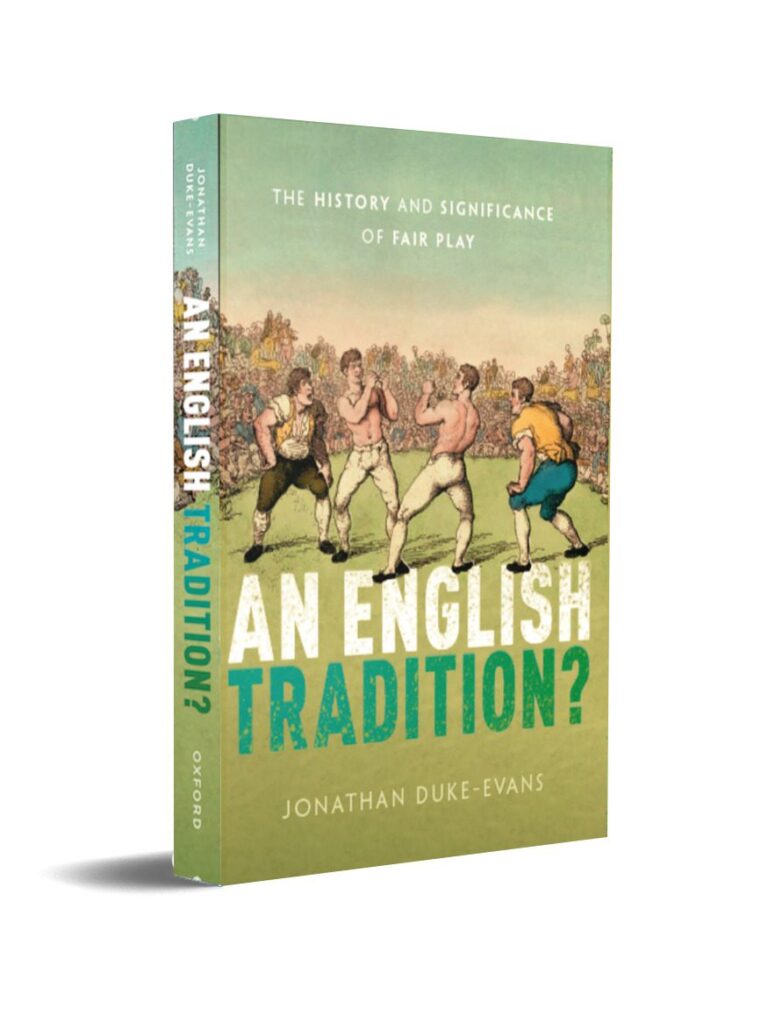
Jonathan Duke-Evans’ new book is called An English Tradition? and it traces the history of the idea of fair play and its place in the British psyche back to the Middle Ages and beyond, looking at the way it manifested itself in sport, the law, religion, marriage, folk tales, and many other areas. 

Here Jonathan answers some questions about his book.

Jonathan Duke-Evans

What made you want to write about fair play?

I’ve heard a lot over the years about fair play being a big part of the English make-up. I wanted to examine where that idea came from and whether there’s anything substantial at the bottom of it.

And is there?

Well, I don’t think there’s much evidence that the English are fairer than everyone else when it comes to the transactions of everyday life: fiddling expenses, handing in valuables or things like that. But there’s plenty to show that the English demand very high standards of fair play from their institutions – governments, law courts, sporting events – and accept that they have a reciprocal obligation to practise it.

How do you think that came about?

To my surprise, I found a lot of evidence for these attitudes going back to the Middle Ages. You can find them in the origins of English law and in the oldest Robin Hood tales. You can find them in the code of chivalry too, and although that applied all over western Europe it was in England that you start to find the values of chivalry applied to ordinary people, not just to knights.

“Fair play” sounds a bit white, a bit male?

Originally, yes, of course it was. But it’s been fascinating to see how the concept widened over time, tracing the changes through the writings of people like Mary Astell, the first great English feminist, and Dadabhai Naoroji, who campaigned for a better deal for India from its Victorian rulers.

Some people think fair play was really invented when the public schools drew up the first rules for cricket, football, and the other games that have come to dominate the world. Do you agree?

No, I don’t. These games were popular games for centuries, played by well-understood rules, for centuries before they were codified in our public schools and universities. Standardising the rules and writing them down was a huge step forward, but it wasn’t the start of the history of sport by any means.

And what about fair play today? Does it still matter?

Most of the time when you hear people talking about fair play, they just mean “well done” or “no problem” or something similar. They’re not really talking about fairness. But the underlying attitude to life is still very much there – but these days we might call it “levelling up”.

Are we only talking about England here...What about the rest of Britain?

I found that the idea of fair play was as strong in Scotland as in England. The first use of the phrase “fair play” in its full modern meaning comes, I argue, in Scotland at the end of the fifteenth century

Do you get the same idea in other countries?

Every civilisation has its own idea of justice. But apart from the countries that have been heavily influenced by Britain, like Australia and to some extent the USA, I don’t think there’s anywhere in the modern world that has quite the same idea of fair play as a concept that is identified as a central feature of the national psyche. You do get some very similar ideas, though, in ancient Greece and Rome, and I’ve looked at these closely in the book.

Where can we buy An English Tradition?

You can buy it directly from Pat Oakley Publishing, or find it on Amazon and all good bookshops.

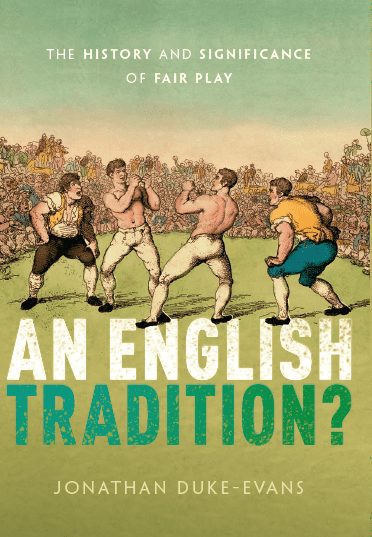
An English Tradition?

The History and Significance of Fair Play

Jonathan Duke Evans

For hundreds of years the British people have claimed that sportsmanship is at the core of their national identity. Jonathan Duke-Evans traces the origins of fair-play, tracing it back to The Dark Ages through stories of chivalry and popular legend, manifesting itself in literature, law, religion and family.

Robert Tombs
Robert Tombs
Daily Telegraph
"This book is a pleasant surprise. Most academic historians would be inclined to “deconstruct” and debunk the idea that fair play was truly a British characteristic... Jonathan Duke-Evans, perhaps because he came to academic writing late, has taken a much more ambitious and wide-ranging approach"
Frederick Studemann, Laura Battle and Alastair Bailey
Frederick Studemann, Laura Battle and Alastair BaileyFinancial Times - The Books To Read in 2023
"Delicate, thoughtful analysis of the relationship between fair play and British national identity"
Henry Hitchings
Henry HitchingsThe Times
"A style at once rigorous and personable...fluently navigating potentially dry or finicky subject matter"

Jonathan Liew
Jonathan LiewNew Statesman 31st Jan 2023
Duke-Evans has committed himself to providing a global overview of a hazily defined ethical concept from virtually the beginning of recorded human history to the present. It is messy at times and ridiculously interesting at others
Ferdinand Mount
Ferdinand MountTimes Literary Supplement
...fascinating, scrupulous and occasionally puckish survey of fair play through the ages.

Sir Keith Thomas
Sir Keith ThomasAuthor of Religion and the Decline of Magic
"An original, scholarly and extremely readable history of what is often regarded, by the English anyway, as an essential attribute of their national character"

Matthew Taylor, Professor of History at De Montfort University
Matthew Taylor, Professor of History at De Montfort UniversityBBC History
This is an ambitious undertaking that Duke-Evans tackles with verve and skill… Duke-Evans makes an excellent case for taking [fair play] seriously as a core component of the values that the British claimed – and still claim – for themselves.

Richard Lofthouse
Richard LofthouseUniversity of Oxford, Oxford Alumni
There are plenty of big questions about who we are as a nation to chew on here. To make your own mind up you’ll have to read the book – a highly enjoyable process...
Catholic Herald
Catholic Herald
Patrick Nash
The book is leavened throughout with the lightness of touch and wry humour of an escaped academic and career civil servant; it succeeds in every respect.
Peter Stansky
Peter StanskyJournal of Interdisciplinary History
This is an extraordinary book with a wide-ranging exploration of the concept of fair play in Britain going back to the eighth century and Beowulf. It also perceptively considers the role of ancient Greece and Rome in forming the idea of fair play. There is a rich discussion of the idea in works by authors such as William Shakespeare, Edmund Spenser, Philip Sidney, Walter Scott, and others.

Elizabeth Dillenburg
Elizabeth DillenburgOhio State University, Department of History
Given the breadth of topics covered, An English Tradition? will appeal to a wide range of readers, includ­ing those interested in literature, politics, sport and cul­ture, and history.... one can find no better foundation for studying this idea than An English Tradition?.

MC
MCA Book For Many Reasons
A book not to be judged by its cover, but fair play to the text. This is a narrative for all reasons – a journey through etymology to English literature and social class – held together with one exhaustively researched thread. Well worth delving into.
Ken Jollans
Ken JollansA wide-ranging and cogent analysis of the tradition and its role in our national identity.
I enjoyed this book a great deal. The author considers the English (and / or British) perception of fair play as a traditional national characteristic using a wide-angle lens, examining the historical roots of the concept and how these have contributed to its modern interpretation. He takes in classical, medieval and a wide range of early modern and more recent sources ranging across literature, political philosophy, social (and particularly sporting) history, featuring among many other characters Beowulf, Robin Hood, the Faerie Queen, John Lilburne, Daniel Defoe and Don Revie (though strangely no mention of Marcelo Bielsa). The historical research which has been carried out is formidable, and the text is excellently referenced. Read this splendid book and make your own mind up as to whether the question mark in the title is justified or not.
Haydn Middleton
Haydn MiddletonFair Play to this new book about Fair Play
I found this an exhilarating read, full of wit and insight, and very much in the Keith Thomas tradition of marshalling a compendious array of often tantalising source material. While its jacket and title may seem to suggest it’s a book about sport, in fact it’s about so much more, ranging across the centuries in an erudite yet highly accessible way and offering intriguing new perspectives on the life of a nation.
Shopping Basket
Scroll to Top